Category: Pastor Wellness
Date Posted : 03-Feb-2026
An AI church receptionist is a voice assistant that answers your church’s phone 24/7 — greeting callers by name of ministry, answering questions about service times, routing prayer requests, and booking appointments without adding staff. The need is real: 49% of American adults have searched for a new congregation, according to Pew Research Center, and their first contact is often a phone call that arrives outside office hours. This guide explains how AI receptionists for churches work, what they handle, and how to evaluate one — drawing on more than 20,000 minutes of real ministry call data from Missional Agents deployments.
What Is an AI Church Receptionist?
An AI church receptionist is conversational voice software that answers your church’s main phone line, understands what callers need, and responds or acts in real time. Unlike a phone menu (“press 1 for office hours”), a virtual church receptionist holds a natural conversation the way a warm front-desk volunteer would.
Modern systems are trained on your church’s own facts. MIRA — Missional Agents’ Ministry Intelligence Respondent Assistant — handles more than 250 call scenarios across 26 ministry categories, including:

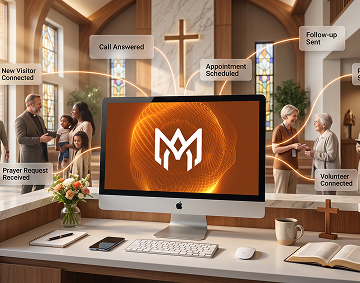
Service times, locations, and directions
Prayer requests captured and routed to your prayer team
Appointment and facility booking requests
Event questions, ministry sign-ups, and volunteer inquiries
Messages taken and summarized for the right staff member
Why Do Churches Need a Church Answering Service?
Churches need a church answering service because the moment a seeker calls is the moment your church makes its first impression — and most of those moments happen when nobody is at the desk. Pew Research Center found that among Americans who searched for a congregation, moving was the most common trigger (34%), and location mattered to 70% of searchers. New-to-town callers ask basic, answerable questions: When are services? Is there childcare? How do I speak with a pastor?
The same Pew study found that quality of sermons (83%) and feeling welcomed (79%) drive the final choice. A warm, immediate answer on the phone is the earliest “welcome” your church can offer.
Traditional options fall short in different ways. Voicemail answers nothing. A human church answering service is available but expensive per call, and outside agents don’t know your ministries. Office staff and volunteers know everything — but only during office hours, and repetitive calls pull them away from people who need shepherding.
How Does AI Call Handling for Churches Work?
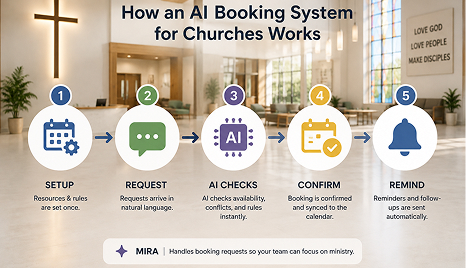
AI call handling for churches works in five steps, from knowledge base to follow-up:
- Build the knowledge base: Your church’s canonical facts — service times, campuses, staff, ministries, events — are loaded into the system once, then updated as things change.
- The AI answers your main line: Callers hear a natural, warm voice, not a menu tree. This is church phone automation without the robotic feel.
- Intent recognition: The system identifies what the caller needs — information, a booking, a prayer request, a message — and responds in seconds.
- Action and escalation: Routine requests are completed on the call. Sensitive calls, emergencies, and pastoral care needs are escalated to a live person according to rules your church sets.
- Summaries and follow-up: Every call produces a summary for your team, so automated church communication never means invisible communication.
For multisite churches, systems like MIRA pool call minutes across campuses, so one plan covers every location’s line.
What Can a Virtual Church Receptionist Handle?
A virtual church receptionist can handle the large majority of inbound church calls — the routine, repetitive questions that consume staff time. Missional Agents’ production data, drawn from 20,000+ deployed call minutes, spans 250+ scenarios in 26 categories. The most common are below.
| Call category | Typical caller questions | What the AI receptionist does |
|---|---|---|
| Service times & directions | “What time is Sunday service?” “Where do I park?” | Answers instantly with campus-specific details |
| Prayer requests | “Can someone pray for my family?” | Captures the request and routes it to the prayer team |
| Bookings & scheduling | “Can I book the fellowship hall?” | Takes booking details or schedules a staff callback |
| Events & ministries | “When is VBS registration?” | Answers from the church’s event knowledge base |
| Giving questions | “How do I give online?” | Directs callers to the church’s secure giving channel |
| Pastoral care | “I need to talk to a pastor.” | Schedules a callback — or escalates immediately in a crisis |
The pattern across deployments is consistent: smart receptionist for churches technology absorbs the routine so people can handle the personal.
AI Receptionist for Churches vs. Traditional Phone Options
An AI receptionist for churches outperforms traditional options on availability and consistency, while costing less than human answering services. Here is the honest comparison:
| Option | Availability | Ministry Knowledge | Typical Cost | Consistency |
|---|---|---|---|---|
| Voicemail | 24/7 (passive) | None | Minimal | Callers hang up; messages pile up |
| Human answering service | 24/7 | Generic scripts | Per-call fees add up | Varies by agent |
| Office staff / volunteers | Office hours only | Excellent | Staff time is the cost | Warm but unavailable nights/weekends |
| AI church receptionist | 24/7 (active) | Trained on your church | Flat monthly plan from $249 | Same warm answer, every call |
The right frame is not replacement. An AI assistant for pastors is digital support staff: it takes the phone off your team’s plate so ministry staff can focus on shepherding people, not managing hold queues.
Hear it yourself: MIRA answers a live demo call at missionalagents.com — every plan starts with a 14-day free trial. (CTA 1)
How AI for Ministry Communication Expands Outreach
AI for ministry communication expands outreach by making your church reachable at the exact moments seekers reach out — which, increasingly, is when AI itself is failing them. A May 2026 multi-university study (BYU, Baylor, Notre Dame, and Yeshiva) surveyed 1,125 U.S. adults and tested 14 leading AI models, finding that AI assistants systematically omit faith from life’s hardest questions — pointing people to therapists, teachers, and friends, but rarely to a pastor.
That gap is your opportunity. When someone in grief, transition, or crisis finally calls a church at 9pm on a Tuesday, the churches that answer are the churches that reach them. Every answered call is a greeted seeker; every captured prayer request is a pastoral connection that would otherwise have evaporated into voicemail.
Automated church communication also compounds outreach after the call: summaries, callbacks, and follow-ups mean first-time contacts become second conversations. Paired with a broader AI tool for church outreach, the phone becomes a front door instead of a bottleneck.
Is Church Phone Automation Right for Your Ministry?
Church phone automation fits your ministry if several of these are true:
Calls go to voicemail on evenings, weekends, or midweek gaps
Staff or volunteers spend hours weekly answering the same questions
You run multiple campuses sharing limited office coverage
Messages taken and summarized for the right staff member
A small team is wearing too many hats already
Keep three guardrails regardless of platform: always maintain human escalation paths for pastoral care and emergencies, be honest with callers that an assistant is helping them, and review call summaries weekly so leadership sees what your community is actually asking.
Getting Started with Automated Church Communication
Getting started with automated church communication takes days, not months:
1. Audit your calls: Count missed calls and after-hours voicemails for two weeks.
2. Gather your facts: One document with service times, campuses, staff, ministries, and events becomes the knowledge base.
3. Pilot free: Missional Agents offers a 14-day free trial of its Church AI receptionist, with plans at $249/month and $699/month — pooled minutes included for multisite churches.
4. Set escalation rules: Decide which calls always reach a human, and who is on call.
5. Measure: Track answer rate, bookings made, and prayer requests captured against your audit baseline.
Explore how AI for churches extends beyond the phone as your team grows into it.
FAQs: AI Assistant for Pastors and Churches
How much does an AI receptionist for churches cost?
Missional Agents plans start at $249 per month, with a $699 per month plan for larger and multisite churches — both with pooled minutes across campuses and a 14-day free trial. Compare that with per-call human answering services or the staff hours currently absorbed by phone duty.
Can a smart receptionist for churches handle emergencies and prayer requests?
Yes — with the right design. Prayer requests are captured word-for-word and routed to your prayer team. Crisis and emergency calls are recognized and escalated immediately to a live on-call contact your church designates. Automation should never be the last stop for someone in crisis, and a well-configured system makes sure it isn’t.
Do AI tools for churches replace staff or volunteers?
No. AI tools for churches work as digital support staff: they absorb repetitive operational work — answering the same twelve questions, taking messages, booking rooms — so pastors and volunteers spend their limited hours on people, presence, and discipleship. Churches that deploy them typically redirect saved hours into ministry, not headcount cuts.
How is an AI church receptionist different from a church answering service?
A church answering service uses human agents reading generic scripts, billed per call, with no knowledge of your ministries. An AI church receptionist is trained on your church’s actual information, answers unlimited routine calls for a flat monthly rate, acts instantly (booking, routing, summarizing), and improves as your knowledge base grows.
Does church phone automation work for multisite churches?
Yes — multisite is where it shines. One system answers every campus’s line with campus-specific service times, directions, and staff routing, while call minutes are pooled across locations under a single plan. Central staff get unified call summaries instead of five separate voicemail boxes.
Transform Ministry Outreach with an AI Church Receptionist
Every unanswered call is a seeker un-greeted, a prayer request un-prayed, a booking un-booked. An AI church receptionist closes that gap: 24/7 availability, your church’s own knowledge, warm and consistent conversation, and human escalation where it matters — proven across 20,000+ minutes of real ministry calls.
Missional Agents builds digital support staff for churches, so your people can focus on shepherding people. Start your 14-day free trial of MIRA, the AI Receptionist for churches, at missionalagents.com — and let your church answer every call.
The 73% of pastors considering leaving ministry don't have to become another statistic. We've created a ministry model that depends on superhuman capacity. When pastors inevitably prove to be human, we act surprised. The system is set up for failure—but it doesn't have to be. After working with 500+ churches, I've seen that sustainable ministry isn't just possible; it's the only path forward that honors both the calling and the called.
Earl Ricker - Chairman, Missional Agents | Former Pastor